

Florida Poly and Orlando College of Osteopathic Medicine Partner for Innovative 6-Year Medical Degree Program
by RYAN MILEJCZAK
In Polk County, and in much of both Florida and the country at large, we’re facing a massive shortage of doctors. And as our state’s population continues to boom, the issue is only getting more pressing. There are many barriers to fixing this shortage, but one of them is the amount of time it takes to become a doctor, traditionally taking at least eight years of schooling.
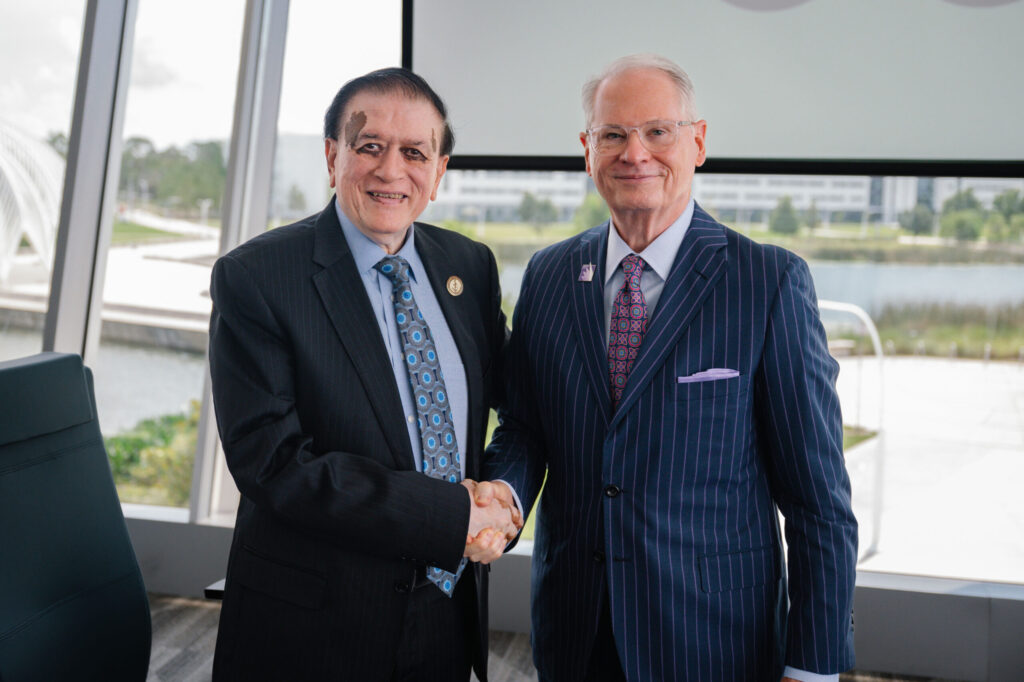
A new partnership between Florida Polytechnic University and Orlando College of Osteopathic Medicine hopes to ease that challenge with a new degree pathway that will take only six years.
“One of the challenges we’re facing in Florida over the next decade or so is that it is expected that we’ll have a shortage of 18,000 doctors in our state,” explains Bryan Brooks, VP for Student Affairs, Enrollment Management, and Strategic Communication at Florida Polytechnic. “In many places, it’s a challenge to find medical doctors because of the way our state has grown.”

The team at Florida Polytechnic knew they were in the perfect position to help alleviate this shortage, but before they could make it happen, they needed to find a school to partner with. This is where OCOM came in.
“We had been looking for local university partners who can not so much share the load as work together to accomplish common goals,” recounts Brooks. “The partnership came about through a connection I made with the dean at OCOM, Robert Hasty.”
“I’m a big believer that the quality of all our lives is dependent on the relationships we have, and that goes for organizations as well,” says Dean Robert Hasty of OCOM. “It was Dr. Chet Evans, a retired university provost at Rollins, who introduced me to Bryan Brooks at Polytechnic. We started exploring the idea, and one thing led to another.”
After they began talking about the partnership, it became clear they could create a six-year program that would condense the time it takes to get a bachelor’s degree and DO (Doctor of Osteopathic Medicine). And so, the partnership was born.
“This new partnership is a six-year, BS DO program. We’re taking 20 students per year currently, and we’re looking for the best and brightest students who want to become physicians,” Hasty explains.
Both institutions bring innovation to the partnership. OCOM is Florida’s newest medical school, launched in 2024, featuring what Hasty calls “the most modern medical school curriculum in the country,” while Florida Poly is the state’s only exclusively STEM-focused university with an 18:1 student-to-faculty ratio and state-of-the-art laboratories.
“We’re known for a very rigorous program here at Florida Polytechnic,” explains Brooks. “So it just made sense that a student that can get into Florida Polytechnic will have no problem getting into OCOM. And with this program, we eliminate that extra admission step and streamline the whole admissions process.”
Students in the program will study for two years at Florida Polytechnic, and then four years at OCOM.
“It’s an incredible opportunity we’re giving local kids to become a physician and do it in only six years,” Hasty adds.
“We’ll be able to prepare medical doctors faster to be able to step into the economy and help fill that need for doctors,” says Brooks.
Brooks also underscores the local impact of this program.
“93% of students at Florida Polytechnic are from Florida, and 88% of students that graduate remain in the state,” he notes. “Our students also graduate with the lowest debt and highest salaries, and we have a very high job placement rate.”
That means that those who graduate from this program are highly likely to stay right here in the Sunshine State, meaning more doctors for our growing population.
“One of our big things is to get folks from Central Florida who want to stay here and want to practice here,” adds Hasty.
“Polk is the fastest growing county in America, and we want to give opportunities right here. I’m a big believer that if we can get folks here and train them as excellent physicians, it’s going to be incredible in terms of serving the public.”
The program will begin next year for the Fall 2026 semester and will be limited to just 20 students. Those interested will need a minimum SAT score of 1390 or ACT score of 31, and a 3.5 GPA. The Medical College Assessment Test, or MCAT, is not required.
“The physician shortage is one of those things that looks like a challenge, then all of a sudden you wake up in 2033 and realize it’s turned into a crisis if you don’t find a way to get out in front of it,” says Brooks.
“We have to find a way to overcome that, and that’s a big part of what we’re doing here to help solve that challenge.”