
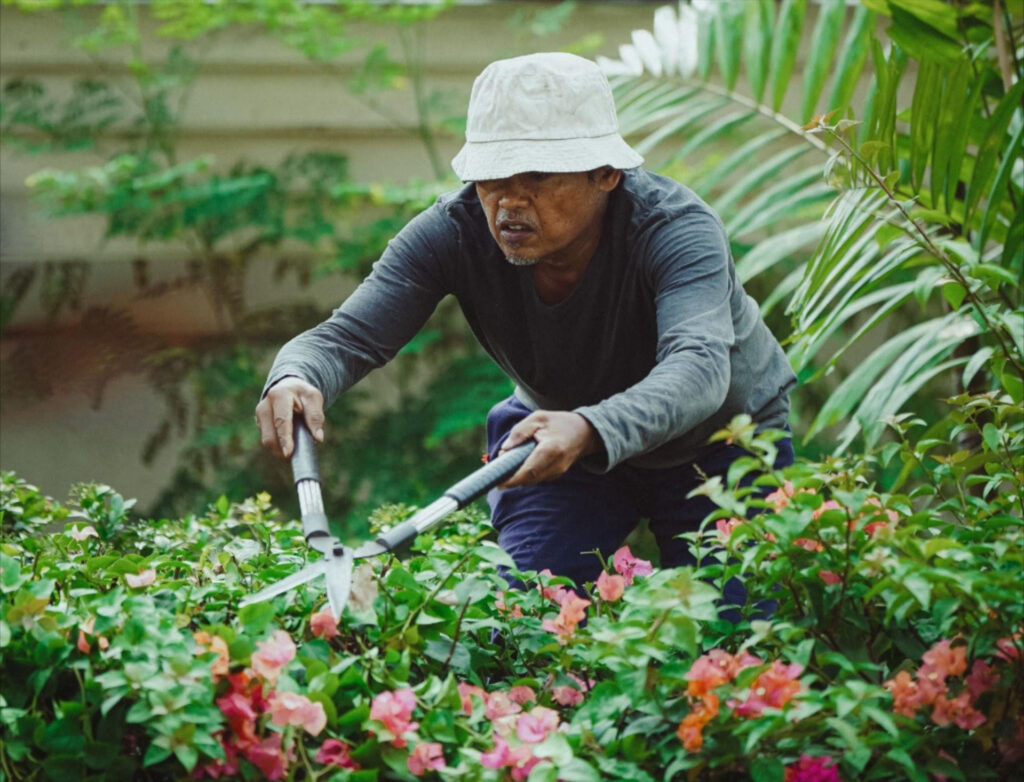
by ANGELIKA KEENE, UF/IFAS
Have you ever spent a morning in the garden and realized your back, knees, or shoulders got just as much of a workout as your plants did?
If you garden, you probably don’t think of yourself as exercising. You’re just gardening. But when you’re bending, kneeling, lifting, carrying, twisting, pulling, and reaching, your body is doing a lot of work.
And here in Florida, we get to add heat and humidity to the mix!
Gardening is rewarding and can support both physical and psychological health (Park et al., 2016; Park et al., 2012). But if we want to keep gardening and enjoying it, we also need to take care of the body doing the gardening.
Your body is your most important gardening tool.
Prepare Your Body Like You Prepare Your Garden
Before we plant, we prepare the soil. We choose the right tools. We think about what our plants need.
We should give our bodies that same attention.
Stretching can help improve flexibility and range of motion, prepare our muscles for movement, and help reduce the risk of strains (Mayo Clinic, 2023; U.S. Department of Veterans Affairs, 2022).
This is especially important for gardeners because we are constantly changing positions. We bend down to pull a weed, reach overhead to trim a plant, kneel to plant something new, and twist to move a pot.
Taking a few minutes to warm up and stretch before gardening can help get your body ready. Gentle stretching afterward can also help with stiffness and recovery.
You don’t have to spend a lot of time doing it. A few minutes is better than nothing.
Gardening Is Strength Training, Too
Stretching is only part of the picture. We also need strength.
Strength training can help build muscle and bone density, improve stamina and endurance, and support the joints we depend on while gardening.
And here’s something I love about this: many of the movements we practice in strength training are the same movements we use in the garden.
Think about it:
- Squats can help prepare us for lifting.
- Hip hinges are similar to the movement we use when bending and digging.
- Rows help strengthen muscles used for pulling.
- Push-ups can be modified by doing them against a wall.
- Farmer carries are similar to carrying gardening supplies.
- Even a watering can can become part of a functional strength exercise.
The goal isn’t to turn gardening into a trip to the gym. It’s about helping our bodies become stronger and better prepared for the things we already enjoy doing.
Don’t Forget the Florida Heat
Gardening in Florida comes with another challenge: the heat.
Pay attention to the heat index. Drink water before, during, and after gardening. Wear sun protection, protect yourself from insects, and take regular rest breaks. Heat-related fatigue is real, and becoming overly tired can increase the risk of injury.
And please don’t wait until you’re completely exhausted to take a break.
I know how easy it is to think, “I’ll just finish this one thing.”
Then one thing becomes five more things.
Your garden will still be there.
Take the break.
Make Gardening Work for You
Not everyone’s body moves the same way, and that’s okay.
If bending is difficult, try a raised bed. Use a garden stool or kneeling pad. Choose tools that are comfortable to use. Garden for shorter periods of time. Slow down. Alternate tasks so you’re not repeatedly using the same muscles and joints.
These aren’t signs that you can’t garden. They’re ways of making gardening work for you.
And if you have a previous injury or health condition, follow the recommendations of your health care professional.
Small Changes Can Help You Keep Gardening
You don’t have to completely change your gardening routine.
Start small.
Stretch before you garden. Build your strength. Drink some water. Take a break. Change positions. Pay attention to what your body is telling you.
Those small changes can help you garden more comfortably and safely—and hopefully keep doing something you enjoy for many years to come.
We spend a lot of time taking care of our gardens. Let’s remember to take care of the gardener, too.
Your body is your most important gardening tool. Take care of it, and it will take care of you.