
Senior Fall Prevention Starts With Strength Training
by SHAYLYNN MARKS
For many older adults, a single fall can change everything. It can impact your confidence, independence, and the ability to move through daily life without fear. That’s why trainers like Ken Snell, co-owner of All American Gym in Lakeland, focus on building strength and balance.
“A lot of falls can be prevented by leg strength training,” he says.
Snell has been in the fitness world for more than 50 years and also teaches wellness and fitness. He says many seniors assume strength training has to look intense to be effective. In reality, the most helpful movements are often the simplest, and they can start at home.
Start With an Armchair
Snell’s go-to exercise for beginners doesn’t even require a gym membership and can be done right at home.
“Just take an armchair,” he says. “Stand up while holding on to the armrest. Sit down. Stand up, sit down.”
Snell describes it as a bodyweight squat with built-in support. He recommends starting with what is realistic, even if it’s fewer than 10 repetitions, and working up slowly.
“Your first little goal is to be able to stand up and down out of that chair without having to push off the armrest,” he says.
Snell says it’s an often overlooked milestone that can make a big difference.
He once trained an 89-year-old man who had one request: He wanted to stand up from the armchairs he used during chess games without pushing off the armrests.
Snell says they worked on leg strength for a couple months, and the man returned, thrilled.
“He said, ‘Ken, I can do it!’ ” Snell recalls.
Why Legs Matter for Balance
Snell says lower-body strength has a ripple effect. Stronger legs can help older adults steady themselves when stepping up onto a curb, stepping down from a porch, or even catching themselves after a trip.
“If you notice … the elderly population, they decrease the stride,” Snell says. “In other words, they shuffle.”
He says many seniors shorten their steps because it feels more stable. When muscle weakens over time, walking becomes a careful balancing act, and the shuffle becomes a strategy.
He believes seniors should prioritize strengthening their leg muscles to help them feel more secure in their stride.
Safe Ways to Progress
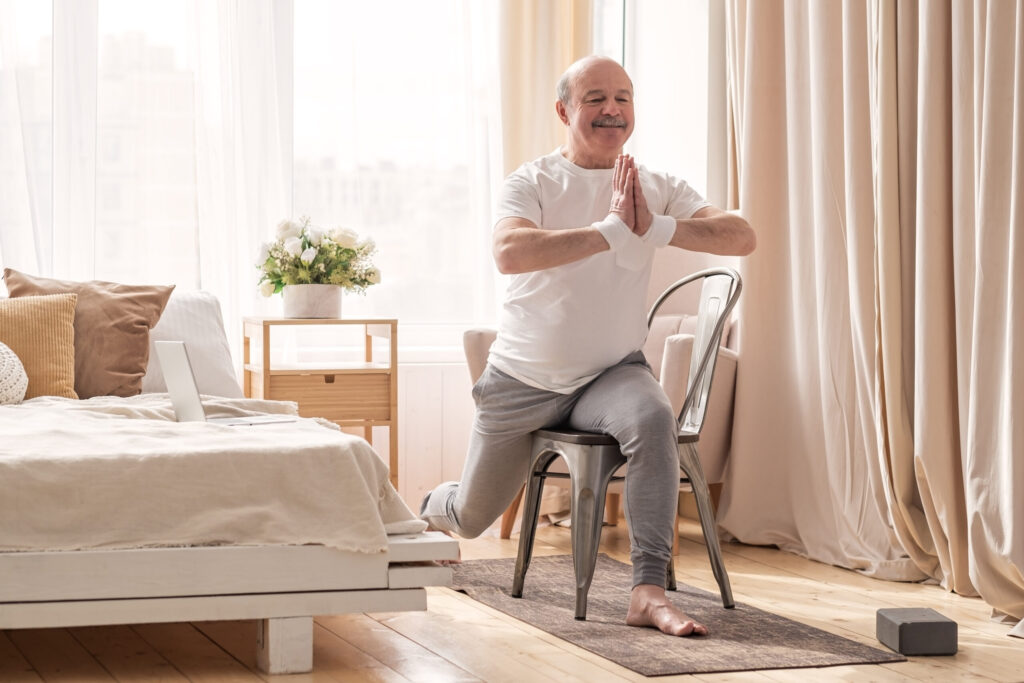
Once chair stands feel easier, Snell suggests adding a second lower-body exercise that still prioritizes stability and recommends practicing lunges with support.
“Grab each armchair for balance and stability,” he says. “Then just step a little forward. [You] don’t even have to do a full lunge yet.”
A chair behind you can serve as a safety backup if your legs get tired, he added, preventing a fall.
Snell calls it “progressive resistance exercise” — building strength little by little, using only what your body can handle safely.
“It’s not about getting ripped,” he says. “It’s about progress — and making your day-to-day life easier.”
When Strength Training Becomes Personal
Nancy Georges of Lakeland, a 74-year-old world record-holder in the deadlift, says lower-body strength matters more with age than many people realize.
“You need strong legs when you get older, right?” she says.
That idea became more real for her around Thanksgiving when she slipped and fell in her kitchen.
“The first thing I thought of was … ‘I didn’t break anything, right?’ ” Georges says.
She was thankful she got up on her own and didn’t break a bone. Around the same time, she says, a retired friend had a similar fall but suffered a severe femur fracture.
“I was like, ‘Oh my God, that could have been me,’ ” Georges says.
Georges believes weight training helped her in that moment.
“I think the weight training saved me,” she says. “It gives you better balance.”
Balance: A Skill You Can Train
Georges says balance is built into strength training, especially when working with free weights.
“When you work with free weights … you’ve got to have balance,” she says.
She prefers free weights because the body has to stabilize, not just move through a fixed path.
“Machines help you with form and doing it correctly,” she says, “but the free weights … it’s more of a whole-body exercise.”
Snell agrees that strength and balance are connected, and he encourages seniors to work at a pace that feels safe for them.
Core Strength Without Getting on the Floor
Snell says seniors can also build core strength without complicated routines.
One option many people never consider is doing ab work in bed.
“All you do is cross your arms across your chest and you just do a crunch,” he says.
He also mentions isometric core work, where the muscle contracts without moving.
“You can just lie in bed and tighten your abs up and hold it for so many seconds and then release,” he adds.
Keep It Consistent
Both Snell and Georges return to the same idea that consistency beats intensity.
Snell says seniors who feel intimidated should focus on what is feasible and repeatable.
Strength doesn’t have to start in a gym. It can start in your living room with a steady hand on a chair back and a few minutes of effort.
As Georges puts it, “We’re never too old to start this.”
For seniors, the safest plan is often the simplest. Build strength now, so your body is ready for the moments you can’t predict.